Why "How Much Does a Screen Room Cost?" Is the Wrong First Question
If you search "motorized screen room cost Alberta" hoping to find a number you can hold onto, you'll get a range so wide it's almost useless. That's not contractors being evasive — it's a reflection of how many genuinely different things a "screen room" can mean. A single motorized screen dropped into an opening on an existing pergola is a fundamentally different project from a complete built outdoor room with a custom post-and-beam structure, matched cladding, a proper roof, vented soffit, and Wizard motorized screens on all four sides. Both are legitimately called screen rooms. Their investment levels are not comparable.
This article walks through the factors that actually determine what a motorized screen room investment looks like — so you can self-qualify, prepare the right questions for your site assessment, and understand why the quote you receive is what it is. These are the same factors we walk through on every site visit before we ever write a number down.
Factor 1: Screens Only vs. a Complete Outdoor Room
This is the single biggest driver of investment, and it's the factor most homeowners don't fully consider when they start researching.
Screens-Only Installation
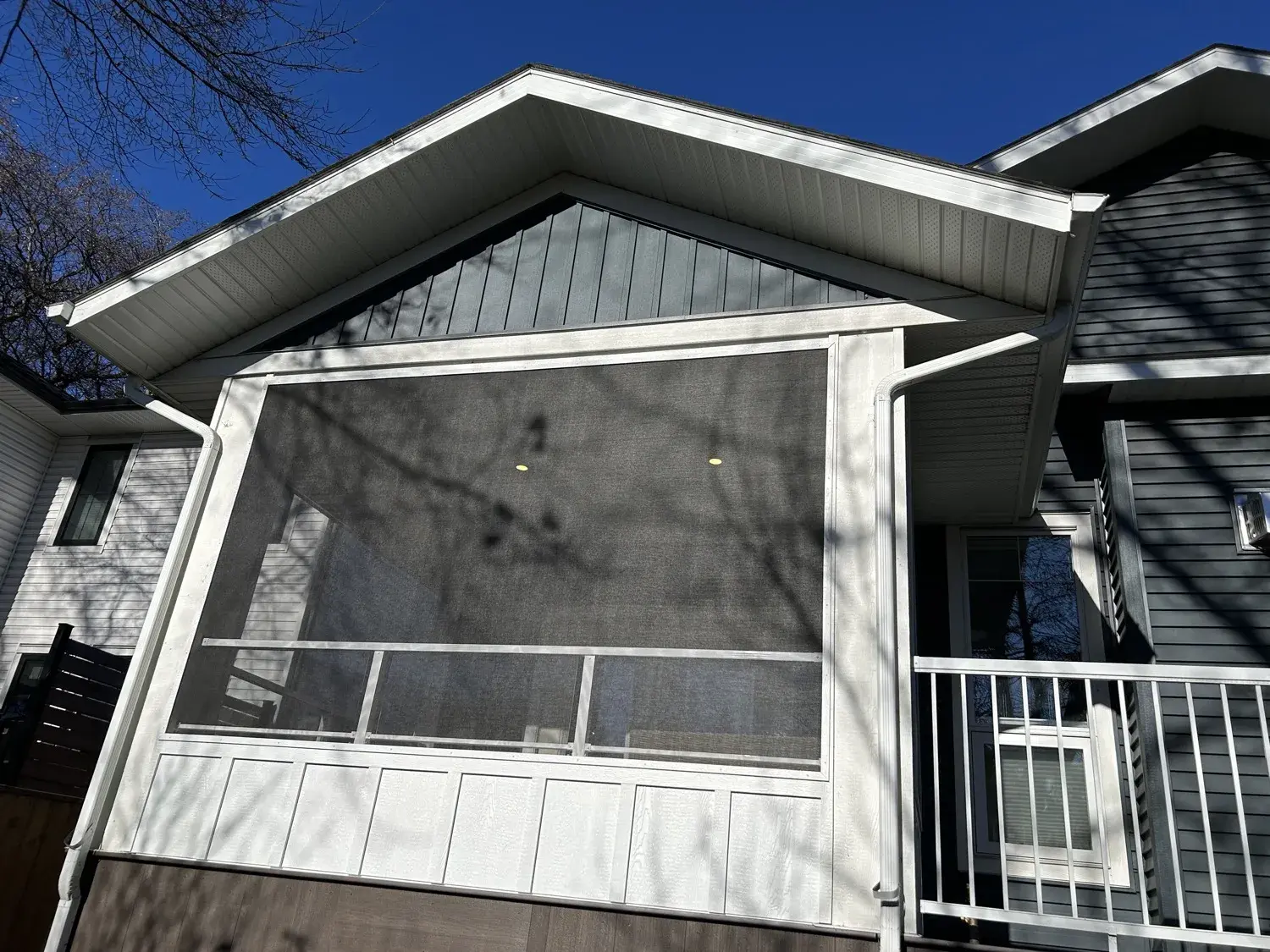
If you already have a covered structure — a solid-roofed deck addition, a four-season sunroom frame, or a covered patio with defined posts at all four corners — a screens-only installation fits Wizard motorized screens into that existing structure. The cassettes mount to the existing ceiling or beam, the guide channels run down the existing posts or walls, and the screens travel between them. This is a tighter scope of work, and the investment reflects that.
A Complete Built Outdoor Room
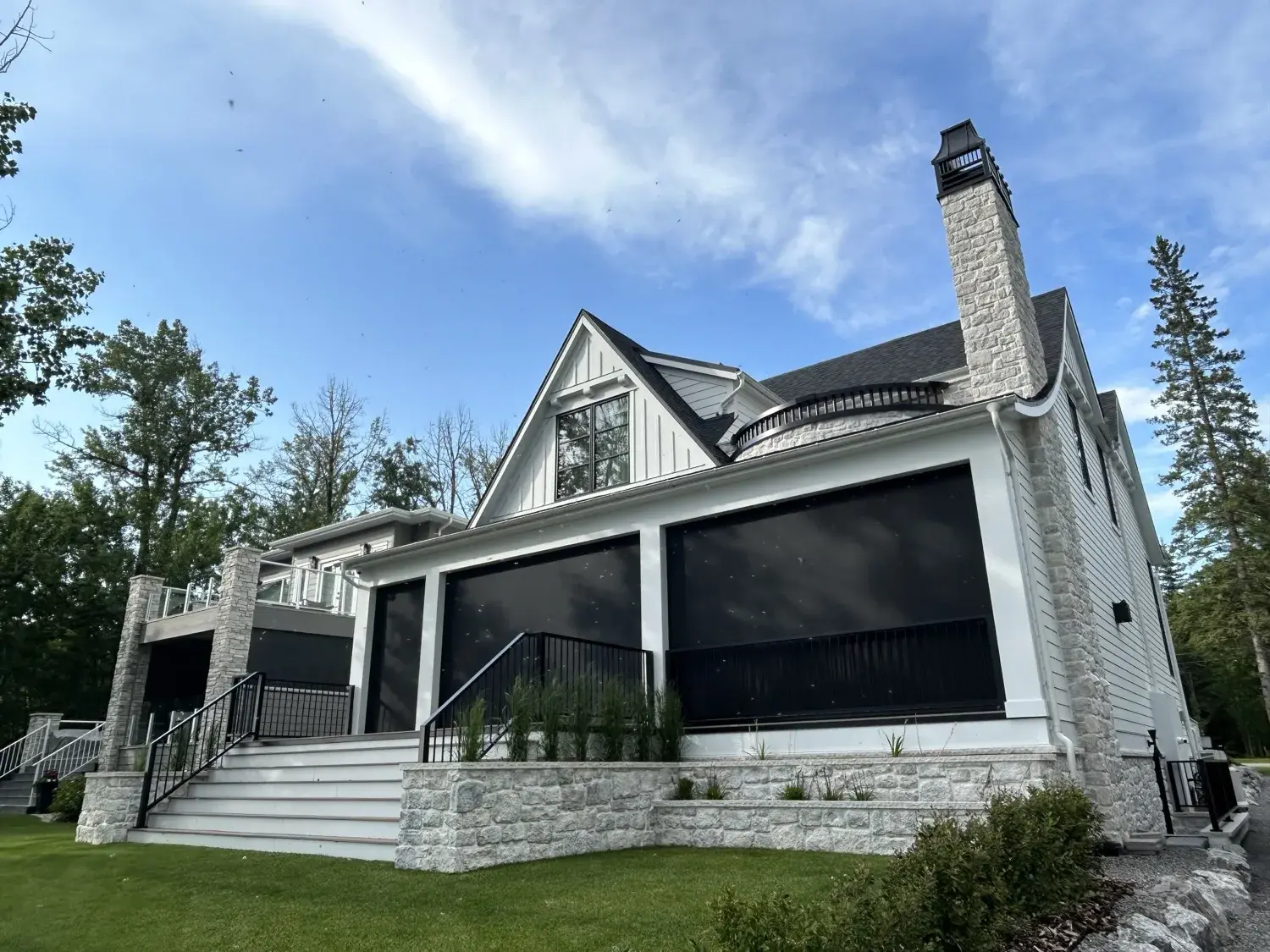
Most lakefront and acreage homeowners in Central Alberta are not starting with an existing enclosed structure. They have an open deck, a pergola, or bare space at grade. Building a complete outdoor room means starting with a custom post-and-beam structure, cladding that exterior to match the home's existing siding and trim profile, adding a proper roof designed to handle Alberta's snow loads and shoulder-season weather, and finishing it with vented soffit — all before a single screen is hung.
PJM's approach to screen rooms is deliberately this second model. We build the whole room, not just hang screens. The result looks like it was always part of the house and performs like a proper structure in Central Alberta conditions. But it's a more involved project, and the investment reflects the scope. When you receive a PJM quote, it covers structure, cladding, roof, soffit, and Wizard screens as a single turnkey package — with the price locked at the point of agreement, not subject to escalation unless the scope changes.
Factor 2: Number and Size of Openings
Every screen is a discrete unit with its own cassette, motor, guide channels, and bottom bar. A room with three screen openings requires three motor assemblies, three sets of guide channels, and three cassettes. A room with five openings requires five. The width and height of each opening matters too — a wide opening requires a wider, heavier cassette and a more robust bottom bar to keep the fabric taut and tracking correctly.
On a Sylvan Lake or lakefront acreage property, it's common to want screens on three or four sides of a deck — a lake-facing wall of two or three wide screens, plus screens on the adjacent sides for cross-wind and bug control. That's meaningfully more hardware than a simple two-opening setup on a suburban backyard deck.
Factor 3: Motorization Level and Smart-Home Integration
Not all motors are equal, and the level of motorization you choose has a direct bearing on the investment.
Manual vs. Motorized
Manual retractable screens exist and cost less upfront. You operate them by hand — pulling down and latching, or pushing up to retract. For a single screen on a small opening, this can be a reasonable choice. For a multi-screen room where you want all screens up or all down simultaneously, manual operation becomes impractical. Motorized systems solve this: one button press deploys or retracts all screens in a zone.
Motorization: Somfy-Powered
Wizard's motorized SmartScreens run on Somfy tubular motors — Somfy is a global leader in motorized shade and screen automation and integrates natively with a wide range of smart-home platforms, including Alexa, Google Home, and IFTTT. The screens are backed by Wizard's manufacturer warranty. Operation is quiet and smooth, by remote, wall switch, or smartphone.
Smart-Home Integration
If you want your screens to respond to a voice command, appear in a home-automation app, or trigger on a schedule or weather sensor, smart-home integration requires compatible motors and a hub or bridge device. This adds hardware cost and setup complexity. For many lake-property owners who want simple remote-control operation during weekend stays, a standard radio remote is entirely sufficient. For homeowners integrating their deck into a whole-home automation system, the smart-integration route is worth the additional investment.
Factor 4: Screen Fabric and Mesh Choice
The fabric that goes into the cassette is not one-size-fits-all. Wizard offers multiple mesh options, and the choice affects both performance and investment.
- Insect mesh: The standard option — an open weave that stops mosquitoes, flies, and most insects while maintaining nearly full airflow and an unobstructed view. Best for the lake-facing wall where you want the view preserved.
- Privacy or solar mesh: A denser weave that reduces visibility from outside and lowers solar heat gain on south- and west-facing exposures. Useful for urban or suburban decks with neighbours nearby, or for sun-baked afternoon exposures. Reduces airflow somewhat compared to insect mesh.
- Mixed configurations: Many complete screen rooms use different fabrics on different sides — insect mesh on the view side, solar/privacy mesh on the afternoon-sun side. This is a smart approach but involves different cassette loading and can slightly complicate the installation.
The fabric choice affects the per-screen material cost, and mixed configurations add some labour complexity. It's worth thinking through your deck's orientation and how you use the space before your site assessment.
Factor 5: Fixed vs. Retractable Systems
Motorized retractable screens — where the fabric rolls into a cassette overhead — are the premium option. Retractability means the screens disappear completely when not needed, leaving your view and airflow fully unobstructed. This is what most Wizard installations involve.
Fixed screen systems, where the screen fabric is permanently stretched in a frame, exist and cost less. The trade-off is that fixed screens are always visible and always in place — including in winter, where the fabric and frame are exposed to snow loading and UV. In Central Alberta, retractable systems are almost universally preferred for this reason: retract in October, deploy in May, and the system is protected through the season it isn't needed.
Factor 6: Site Access and Structural Preparation
Not all properties are equal to work on. A lakefront acreage with a long access road, a steep waterfront grade, or a deck elevated significantly above ground adds mobilization time and complexity compared to a suburban backyard with flat access. This matters most for complete outdoor room builds, where heavy structural materials need to reach the site and a crew needs working space.
Structural preparation is the other variable. If the deck requires new footings, if an existing structure needs reinforcement before it can support a post-and-beam addition, or if the home's exterior requires modification to properly integrate the new room, that preparatory work is part of the project scope. A site assessment identifies these requirements before the quote is written — which is exactly why we don't produce final quotes remotely.
Factor 7: Permits
In Alberta, adding a permanent structure to your property — which a complete built outdoor room is — typically requires a development permit and, depending on the municipality, a building permit. Permit requirements vary between Red Deer, Blackfalds, Lacombe, and the surrounding County jurisdictions. Screens-only installations on existing permitted structures may not require additional permits in all jurisdictions, but it depends on the municipality and the nature of the work.
Permit costs are real costs. More importantly, the time required to obtain a permit affects your project timeline. If you're targeting a specific date — the long weekend, a family gathering — permit timing needs to be factored in from the start. We discuss permit requirements during the site assessment and include permit considerations transparently in the scope.
Factor 8: Year-Round vs. Seasonal Use
A screen room intended for use from May through September has different structural and finishing requirements than one built for extended-season occupancy. Seasonal-use rooms can be built to a lighter finishing spec in some areas — the roof and structure still need to handle Alberta's snow loads even when the screens are retracted, but the interior finishing expectations are different.
Extended-season outdoor rooms, particularly in Red Deer's climate, benefit from more substantial overhead detailing and finishing that performs across the shoulder months. If you plan to use the space from April through October in Central Alberta, it's worth engineering those details from the start, since retrofitting them later costs more than building it right the first time.
Why the Quote for a Wizard Screen Room Varies: A Summary
- Screens-only on an existing structure vs. a complete built outdoor room with structure, cladding, roof, and soffit
- Number and size of screen openings
- Manual vs. motorized (Somfy-powered) operation
- Standard remote vs. smart-home integration
- Insect mesh, solar/privacy mesh, or a mixed configuration
- Site access and any required structural preparation
- Permit requirements for the specific municipality or county
- Seasonal vs. extended-season use and the structural spec that follows from that
No two combinations of these factors produce the same number. That's why we don't publish a price list for screen rooms, and why any quote you receive remotely — without a site visit — should be treated with caution. The variables that matter most require eyes on the site.
What to Expect From a PJM Site Assessment
As an authorized Wizard dealer serving Red Deer and Central Alberta, PJM Home Advantage begins every screen room project with a free site assessment. We look at the existing structure, the site access, your deck's orientation and exposure, and how you plan to use the space. We walk through the fabric and motor options, explain what the permit process looks like for your specific municipality, and give you a detailed quote before any work begins.
The price we quote is the price you pay — locked at agreement, and it doesn't move unless you change the scope. That's been our practice for twenty years, and it's how we earn the trust of homeowners who are making a meaningful investment in their property.
If you're a lakefront homeowner at Sylvan Lake who's been losing summer evenings to mosquitoes and wind, or an acreage owner who wants to finally use the covered deck you built three years ago, the right next step is a conversation — not a price sheet. Request your free site assessment and we'll give you a clear picture of what your outdoor room can look like and what the investment involves.

PJM Home Advantage
Exterior Finishing Specialists
PJM Home Advantage has been finishing exteriors across Red Deer and Central Alberta for over 20 years. Our team specializes in siding, soffit, fascia, eavestrough, steel roofing, and Wizard motorized screen rooms — built to withstand Alberta's demanding climate.
Have an Exterior Project in Mind?
Get expert guidance from Central Alberta's exterior finishing specialists. We work with premium brands and back every project with manufacturer and workmanship warranties.
Get a Free Quote